rippledesignathon 2025
Sustainable AI through reuse, not regeneration.
Role
- Product Designer
Duration
- 8 hours
Skills
- UI/UX Design
- Designathon
- Prototyping
- Figma
Team
- 4 Designers
3rd at BLOOM Designathon 2026
Prompt
The challenge
For BLOOM Designathon 2026, I teamed up with 3 other university students to tackle the question:
We wanted to focus on the part of the challenge that felt most actionable and something people do daily.
Defining a direction
Our approach
There are hundreds of environmental issues to tackle, from transportation and clothing to food waste. Initially, we brainstormed a wide range of ideas including: a community sharing platform for item borrowing, daily sustainability challenges, and an app that tackled reduce, reuse, and recycle.
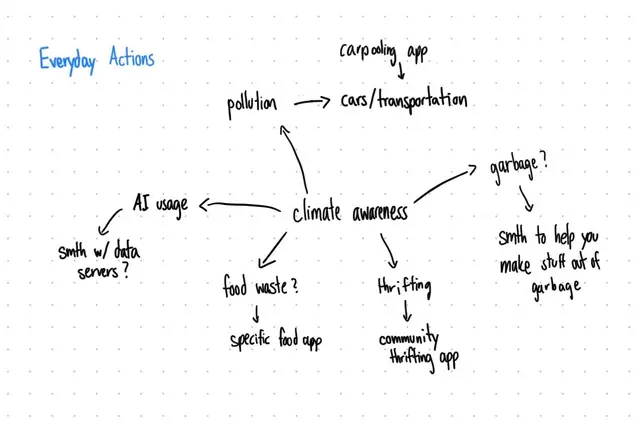
However, we decided to dive into something less commonly discussed.
Problem
The environmental cost of AI is often overlooked.
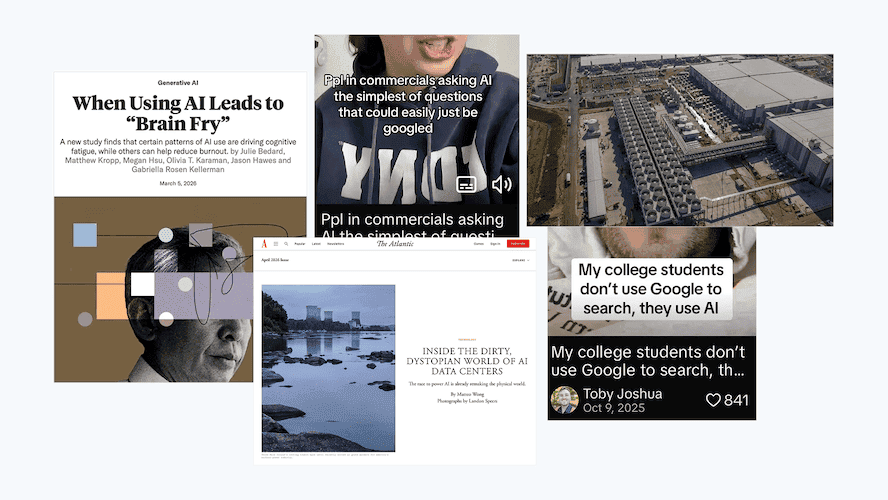
LLMs have become increasingly more popular since the release of ChatGPT in 2022, embedding themselves into our daily lives. People are using them for everything from simple facts to repeated questions that could have been answered before (like 3x5!). Simple Google searches are being replaced by AI ones.
The experience feels so seamless and instantaneous that we often forget about the compute, storage, and energy required to generate these responses.
It is estimated that for every 10 ChatGPT responses, 500mL of water is used too cool down data centers and it's projected that AI water usage could hit 6.6 billion m³ by 2027. Additionally, a ChatGPT response uses up to 10x more energy than a Google search.
Solution
Ripple: A More Sustainable AI Solution
Ripple is a concept for a more sustainable AI experience that focuses on reuse, not regeneration.
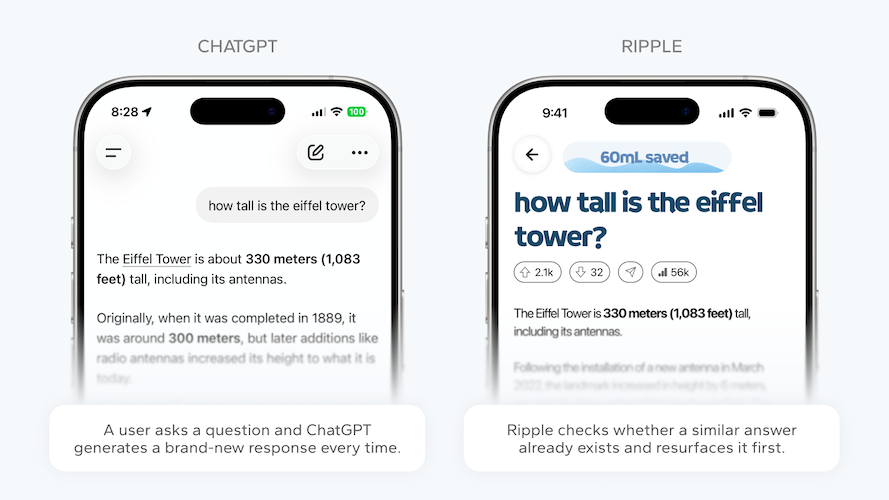
When a user enters a prompt, Ripple searches through a database of previously asked prompts related to the request and resurfaces the most relevant answers. This eliminates unnecessary AI generation, saving on energy and water used by data centers.
If no relevant match is found, Ripple can still respond like your usual LLM, but it prioritizes efficient, low-cost models.
One step at a time
We know that telling people to stop using ChatGPT is unrealistic and unfeasible. So instead of forcing people to stop, why don't we redefine what it means to use an LLM?
In a world where AI is becoming increasingly unavoidable, the right response is not to avoid AI, but rather adapt and address the pressing environmental issues it causes. Ripple makes it easier for people to make a more sustainable choice without asking for drastic changes.
Core Features
Home Page
Users are greeted by a familiar “ChatGPT-like” user interface.
Once a user types in their “prompt”, ripple surfaces existing answers from previously asked prompts, allowing users to select the one that matches their best request.
Response Page
Once a user selects the answer they want to view, they are able open up Ripple's resurfaced response. There, they can view directly how much water they saved as well as ask any follow up questions.
Users can also upvote and downvote answers, which serves as its algorithm to learn what answers are the most relevant.
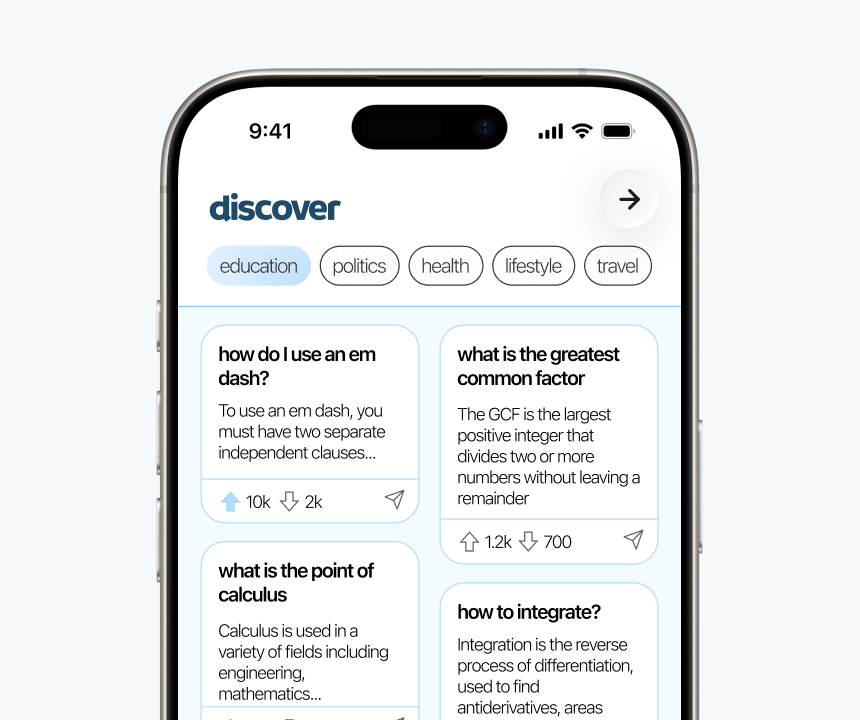
Discover Page
Browse previously asked prompts, encouraging people to learn from existing knowledge instead of generating new responses.
Filter past prompts by selecting categories. There, users can dive into a world of already LLM-generated knowledge.
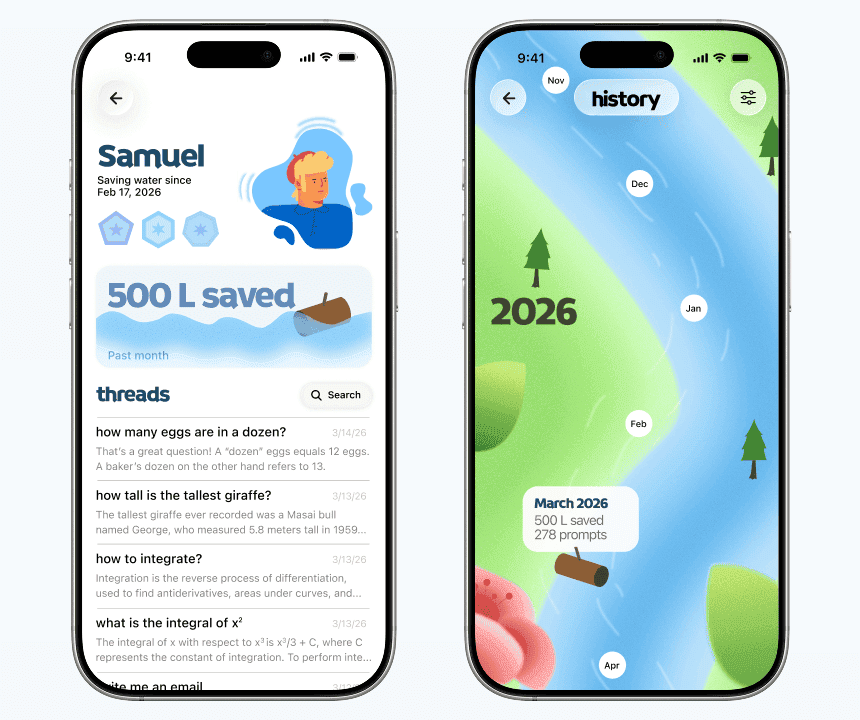
Profile Page
View how many litres of water you've saved in the past month by choosing ripple instead of other AI providers.
Discover your water savings history through an interactive river stream interface.
Receive badges and achievements for reaching water saving milestones, gamifying sustainable behaviour and encouraging users to keep using ripple.
Prototype
Try it out
Final Design Decisions
A familiar, clean, and emotionally effective design
ChatGPT-like Interface
We used a ChatGPT-like interface to allow users to instantly understand what to do, reducing friction and increasing adoption rate to a more sustainble platform.
Ripple and Water Effects
The theme of water is prevalent throughout the design to reinforce the environmental message. The water saving animation, stats, and history river all work together to gamify and encourage sustainable behaviour.
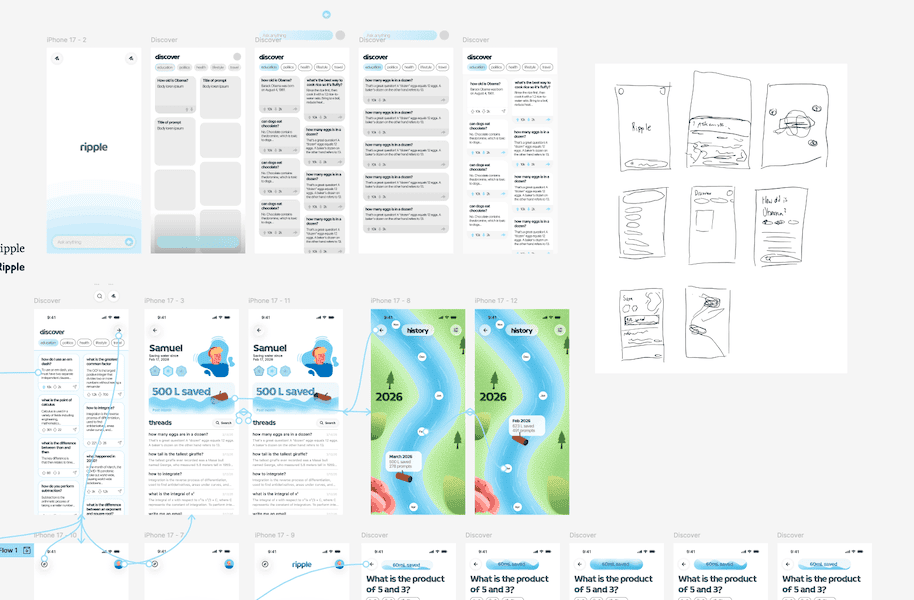
Reflection
What I learned
Think ambitiously
Its okay to have big ideas. Ripple is not fully feasible at the moment, but an inspiring concept for a more sustainable future. So, don't ground yourself in hard reality. Its usually the the most ambitious projects that move the world forward.
Don't perfect designs
Spending time refining the small details is not worth it (especialy within 8 hours). Sometimes you need to step back and focus on the bigger picture and overall system.